
Welcome to LatinCy Newsletter #3.
Time to get back to regular updates on the newsletter. Exciting releases since the last issue including the LatinCy Vocab package and an updated version of Latin BERT. Thanks as always for your interest in the LatinCy project.—PJB
Releases
- Latin BERT v1.2.0: An experimental packaging of the original Latin BERT weights for use with Hugging Face
transformers. https://huggingface.co/latincy/latin-bert - LatinCy Lexicon v0.13: Whitaker’s Words as LatinCy pipeline components for Latin NLP. The package is based on Whitaker’s Words and the Perseus Project’s Lewis & Short dictionary, though with LatinCy-specific corrections and modifications. https://github.com/latincy/latincy-lexicon
- LatinCy Vocab v0.4: Vocabulary list builder for Latin text; takes plaintext input, runs it through a LatinCy spaCy model, and returns structured vocabulary lists. Citation forms (principal parts, gender, etc.), POS markers, and dictionary glosses are sourced from LatinCy Lexicon. LatinCy Vocab is the formatting and aggregation layer. https://github.com/latincy/latincy-vocab
- See also this blog post “Introducing… LatinCy Vocab” from July: https://exploratoryphilology.org/posts/introducing-latincy-vocab/
Updates
- LatinCy Readers v1.9: Corpus readers for key Latin (and now Greek!) text collections with built-in annotation support from the LatinCy NLP pipelines. Updated to support Patristic Text Archive, Corpus Scriptorum Ecclesiasticorum Latinorum, Project Gutenberg, and Wikisource, among others in the recent releases. https://github.com/latincy/latincy-readers
Events
Mon. Oct. 26: “The Flipped Lemma: Repurposing a Latin Lexicographical Resource for Disambiguating Word Senses.” Thesaurus Linguae Latinae Workshop, Munich. Following up on last year’s talk at the TLL on word sense disambiguation for Latin, I return a year later to talk more about building a LatinCy WSD component, and more specifically building out an inverted Lewis & Short—i.e. illustration sentences to lemma/sense—to use as training data for the model.
Publications
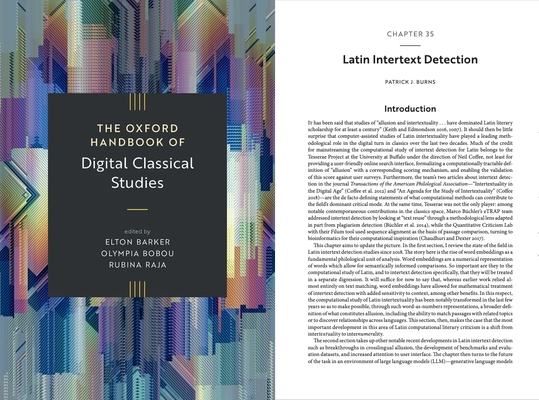
Burns, Patrick J. 2026. “Latin Intertext Detection.” In Barker, E., Bobou, O., and Raja, R., eds., The Oxford Handbook of Digital Classical Studies, 457–468. https://doi.org/10.1093/9780197835210.003.0017.
I have a chapter in the newly released Oxford Handbook of Digital Classical Studies on “Latin Intertext Detection” in which I lay out a recent history of the computer-assisted study of Latin intertextuality after the publication of Neil Coffee’s 2018 “Agenda” article in TAPA (https://doi.org/10.1353/apa.2018.0008). I identify several trends in the scholarship, none more important than the increasing role of word vectors in the study of this literary phenomenon, coining the word “internumerality” to emphasize the degree of change. LatinCy-affiliated vectors are used in the chapter—w2v, fasttext, and Latin BERT v1—for the case study on Macrobius’s identification of parallel passages in Saturnalia.
Blog posts
- “Updating LatinCy XPOS Tags” (March 30, 2026): How can we make the XPOS tags more useful when using LatinCy pipelines? https://exploratoryphilology.org/posts/latincy-xpos-tags/
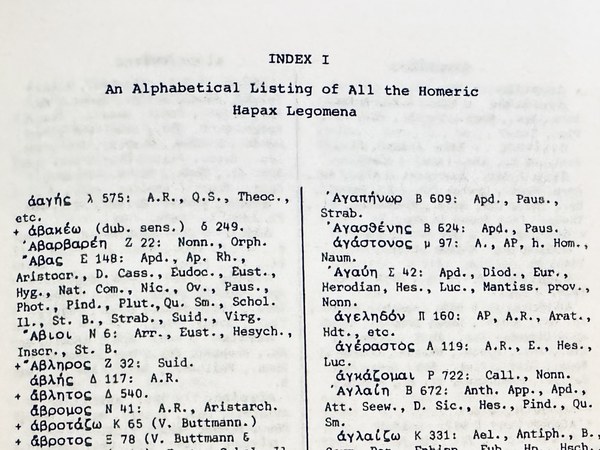
- “Homeric Hapax Tables in Kumpf 1984” (July 31, 2026): How many hapaxes are there in the Iliad and Odyssey? And how do our counts compare to those published by scholars like M. M. Kumpf? https://exploratoryphilology.org/posts/kumpf-1984/
- “Research Recap: CAAS2026 Latin Vocabulary Workshop” (October 13, 2026): Report back from CAAS2026 in Wilmington earlier this month and my workshop on using NLP to help generate Latin vocabulary lists. https://exploratoryphilology.org/posts/caas2026/
Ask LatinCy
Do you have an idea for a Latin NLP project that LatinCy could help with? Do you have questions about how to use LatinCy in your research, teaching, reading, etc.? Submit your ideas to the Ask LatinCy column by emailing patrick@diyclassics.org. We will then publish responses as blog posts in the Exploratory Philology blog.